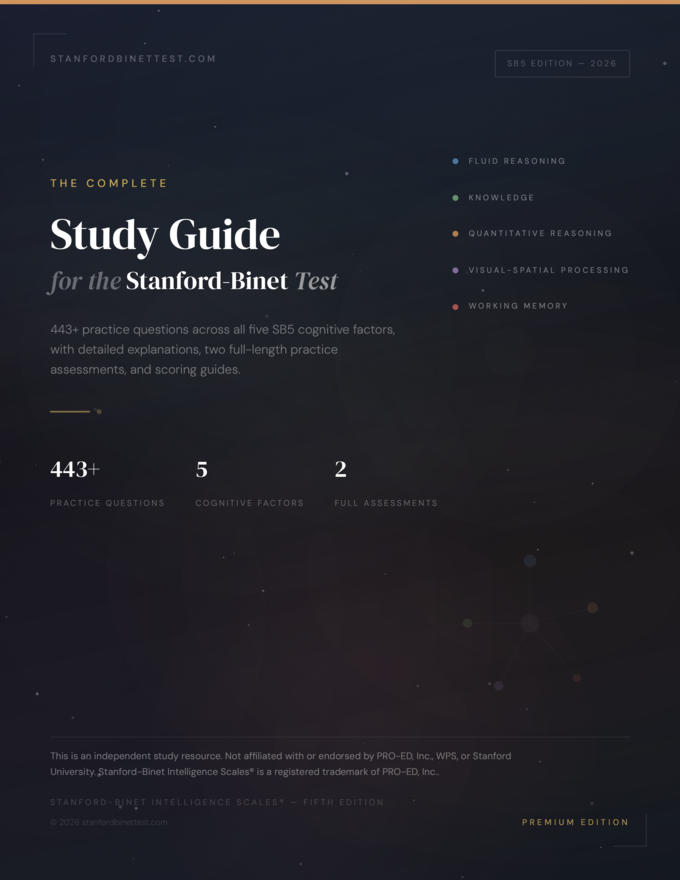
The Complete Study Guide for the Stanford-Binet Test
256 pages of practice questions, visual reasoning challenges, two full-length assessments, and detailed explanations covering all five SB5 cognitive factors.
What's Inside
256 Pages. 443 Questions.
Everything You Need.
Structured to build understanding first, then reinforce with practice across every cognitive factor measured by the SB5.
Understanding the Stanford-Binet
6 chapters: What Is the Stanford-Binet, The Five Cognitive Factors, How the Test Works, Understanding Your Score, Preparation Strategies, and a Cross-Factor Strategy Guide.
Click to previewPractice Question Bank
205 questions organized by factor: Fluid Reasoning (50), Knowledge (40), Quantitative Reasoning (45), Visual-Spatial (35), and Working Memory (35).
Click to previewVisual Questions
138 visual reasoning questions across Fluid Reasoning, Visual-Spatial, and Quantitative Reasoning — pattern recognition, spatial puzzles, and quantitative visuals with detailed explanations.
Click to previewPractice Assessments
2 full-length practice assessments with 50 questions each. 25-minute timed format simulates actual test conditions. Scoring guide included.
Click to previewAnswer Keys & Explanations
Complete answer keys for every question. Each includes a full explanation and, where applicable, a recommended strategy or skill focus.
Click to previewSupplemental Materials
Quick-Reference Factor Cards, Score Interpretation Worksheet, Test-Day Checklist, Parent & Guardian Guide, Score Meaning Reference, and a 30-Day Preparation Plan.
Click to previewThe Five SB5 Factors
Complete Coverage of
Every Cognitive Domain
The Stanford-Binet measures intelligence across five distinct factors. This guide covers all of them in depth.
Fluid Reasoning
FRSolving novel problems using logic, pattern recognition, and abstract thinking.
See exampleKnowledge
KNVocabulary, verbal reasoning, and information acquired through education and experience.
See exampleQuantitative Reasoning
QRNumerical problem-solving, mathematical relationships, and working with quantities.
See exampleVisual-Spatial Processing
VSPerceiving, analyzing, and mentally manipulating visual patterns and spatial relationships.
See exampleWorking Memory
WMHolding and manipulating information in short-term memory for multi-step problem solving.
See exampleWhy This Guide
Built to Help You Prepare
with Confidence
Timed Practice Assessments
Two full-length assessments with 50 questions each in a 25-minute timed format that simulates real test conditions.
Detailed Explanations
Every question includes a full answer explanation with strategy tips. Learn why each answer is correct, not just which one.
138 Visual Reasoning Questions
Purpose-built visual puzzles covering pattern recognition, spatial reasoning, and quantitative visuals that go beyond text-based questions.
256-Page Premium Guide
The most comprehensive Stanford-Binet preparation resource available - covering all five factors with 443 practice questions.
Scoring & Interpretation
Includes a scoring guide and score interpretation worksheet so you can track progress and understand results in context.
30-Day Preparation Plan
A structured day-by-day plan that organizes your study time across all five factors for steady, balanced preparation.
Get the Guide
Start Preparing Today
Instant PDF download. Study at your own pace. Everything you need in one comprehensive guide.
Stanford-Binet Study Guide & Practice Questions
- 443 practice questions across all five cognitive factors
- 138 visual reasoning questions with detailed explanations
- 2 full-length timed practice assessments (50 questions each)
- Complete answer keys with strategy recommendations
- 30-day study plan, factor cards & score worksheets
Understanding the Stanford-Binet
6 chapters that build your knowledge from the ground up
- What Is the Stanford-Binet?
- The Five Cognitive Factors
- How the Test Works
- Understanding Your Score
- Preparation Strategies
- Cross-Factor Strategy Guide
Practice Question Bank
205 questions organized by cognitive factor
Sample Question — Fluid Reasoning
"Telescope is to distant as microscope is to:"
Visual Questions
138 full-page visual reasoning challenges
Each question is a purpose-built graphic visual; not a text description of a picture. You'll work with pattern matrices, spatial rotation puzzles, shape sequences, and quantitative diagrams.
Three difficulty levels: Accessible, Moderate, and Challenging - plus bonus questions.
Practice Assessments
2 full-length tests simulating real conditions
Difficulty distribution: 10 accessible, 20 moderate, 20 challenging. Questions rotate across all five factors, just like the real SB5.
Answer Keys & Explanations
Every answer explained, not just identified
Sample Explanation
"Which word is most OPPOSITE in meaning to PROSPERITY?"
Answer: a) Poverty. This is a Knowledge question testing vocabulary depth. Prosperity means wealth and success; poverty is its direct antonym. "Sadness" and "weakness" are negative but unrelated concepts. "Ignorance" opposes knowledge, not prosperity.
Each explanation identifies the factor tested, the reasoning pattern, and common errors to avoid.
Supplemental Materials
6 reference tools included
- Quick-Reference Factor Cards
- Score Interpretation Worksheet
- Test-Day Checklist
- Parent & Guardian Guide
- What Your Score Means
- 30-Day Preparation Plan
Solving Novel Problems
Fluid Reasoning measures the ability to solve new problems using logic, pattern recognition, and abstract thinking independent of learned knowledge. It's the factor most strongly associated with general intelligence.
Example Question
"If it is raining, the ground is wet. The ground is wet. Which must be true?"
Answer: c) Something made the ground wet — affirming the consequent
50 text questions + visual pattern puzzles in this guide
Vocabulary & Verbal Reasoning
Knowledge measures accumulated information, vocabulary, and verbal reasoning skills. Unlike Fluid Reasoning, it reflects what you've learned through education, reading, and experience.
Example Question
"BRAVE"
Answer: b) Showing courage in the face of danger
40 text questions in this guide
Numbers & Mathematical Thinking
Quantitative Reasoning tests the ability to work with numbers, mathematical relationships, and quantities. Questions range from basic arithmetic to multi-step word problems.
Example Question
"Emma has 12 stickers. She gives 4 to her friend. How many does Emma have now?"
Answer: b) 8
45 text questions + visual quantitative diagrams in this guide
Shapes, Patterns & Space
Visual-Spatial Processing measures the ability to perceive, analyze, and mentally manipulate visual patterns, shapes, and spatial relationships. This factor is heavily tested with visual (non-verbal) items.
Example Question
"A red block is on top of a blue block. A green block is on top of the red block. Which block is in the middle?"
Answer: a) Red
35 text questions + visual spatial puzzles in this guide
Hold, Process & Recall
Working Memory measures the ability to hold information in short-term memory and manipulate it — essential for following multi-step instructions, mental arithmetic, and complex reasoning.
Example Question
"Read once, then cover: 'The brown dog sat on the red mat near the door.' Without looking back, which is correct?"
Answer: c) The brown dog sat on the red mat near the door
35 text questions in this guide
Simulate Real Test Conditions
Each practice assessment contains 50 questions to be completed in 25 minutes. Questions rotate across all five cognitive factors (10 per factor) with a progressive difficulty curve: 10 accessible, 20 moderate, and 20 challenging.
This mirrors the actual SB5 experience - helping you build familiarity with the pacing, question rotation, and pressure of a timed evaluation.
Learn from Every Question
Every question in this guide includes a full answer explanation. Each explanation identifies which cognitive factor is being tested, walks through the correct reasoning, and flags common mistakes.
The goal isn't memorization. It's building the thinking patterns that transfer to the real test.
138 Purpose-Built Visual Puzzles
Unlike text-based questions, visual questions require you to analyze patterns, spatial relationships, and quantitative diagrams directly. Each is a unique SVG graphic designed specifically for this guide.
Three difficulty tiers (Accessible, Moderate, Challenging) plus bonus questions ensure a progressive challenge across Fluid Reasoning, Visual-Spatial, and Quantitative Reasoning.
Everything in One Guide
Six parts. 443 questions. Two full assessments. Complete answer keys. Six supplemental reference tools. All organized in a clear, structured progression from learning to practicing to testing.
Delivered as a single PDF that you can read on screen or print at home.
Understand What Your Scores Mean
The scoring guide helps you calculate results from both practice assessments. The score interpretation worksheet maps your results to SB5-equivalent ranges and percentiles.
Together, they help you identify your strongest factors and where to focus additional practice.
Structured Preparation Timeline
The 30-day plan organizes your study time across all five cognitive factors, with specific chapters, question sets, and assessments assigned to each day. It's designed for 30–45 minutes of daily practice.
Week 1 focuses on the chapters and understanding. Weeks 2–3 cover the question banks. Week 4 brings the practice assessments and review.